
The 9th arrondissement has a reputation as a place people pass through: you come for a meeting near the Opéra, for the department stores, for a train at Saint-Lazare. That is a pity, because a few streets north you find a neighbourhood of artists’ studios, small squares and shopping streets where people really live. Here is what Laura and Hannah recommend to the guests they welcome, starting at the Opéra and slowly working up towards rue des Martyrs.
Around the Opéra: the Paris of the Second Empire
The Palais Garnier
You cannot talk about the 9th without starting here. The opera house built by Charles Garnier can be visited during the day, outside performances: the great marble staircase, the gilded foyer and the auditorium with its ceiling painted by Chagall are worth the trip, even if you have never been to a ballet. In the evening, seeing a performance in this setting is a memory of its own. Tickets go quickly, so it is best to book ahead.
The department stores on boulevard Haussmann
Galeries Lafayette and Printemps face each other on boulevard Haussmann. Even without buying anything, step into Galeries Lafayette for the Art Nouveau dome, then go up to the panoramic terrace to see the Opéra up close and the rooftops of Paris all the way to the Eiffel Tower. Printemps also has a terrace and a beautiful dome. At the end of the year, the animated windows and the giant Christmas tree draw crowds of families: a show in itself, best seen on a weekday.
The Fragonard Perfume Museum
Just behind the Opéra, on rue Scribe, this small museum tells the history of perfume-making through bottles, stills and old objects. A short visit, ideal before or after the department stores.
The Grands Boulevards and their covered passages
Passage Jouffroy and Passage Verdeau
Starting from the Grands Boulevards, on either side of rue de la Grange-Batelière, the string of covered passages is one of the best walks on a rainy day. Passage Jouffroy lines up antique bookshops, toy and walking-stick shops and the entrance of a discreet hotel. It carries on into Passage Verdeau, quieter, where you can browse old prints, vintage cameras and books.
Musée Grévin and the theatres
The Musée Grévin and its wax figures are a hit with children and visitors from abroad. All around, the 9th is an arrondissement of stages: the Folies Bergère on rue Richer, the Olympia on boulevard des Capucines, the Théâtre Mogador, the Casino de Paris and the Théâtre de Paris. There is almost always a musical, a concert or a play a few minutes’ walk from the flat.
Hôtel Drouot and Cité de Trévise
Less known to tourists, Hôtel Drouot is the great Paris auction house. You can walk in freely to look at the items on display before the sales: furniture, paintings, jewellery, all kinds of curiosities. A little further on, Cité de Trévise, a small private street with a fountain, and Square Montholon offer a quiet break.
The Nouvelle Athènes: the artists’ 9th
In the 19th century, painters, writers and musicians settled on the slopes north of the church of Notre-Dame-de-Lorette. The area was named the Nouvelle Athènes, after the neoclassical architecture of its town houses.
The Musée de la Vie romantique
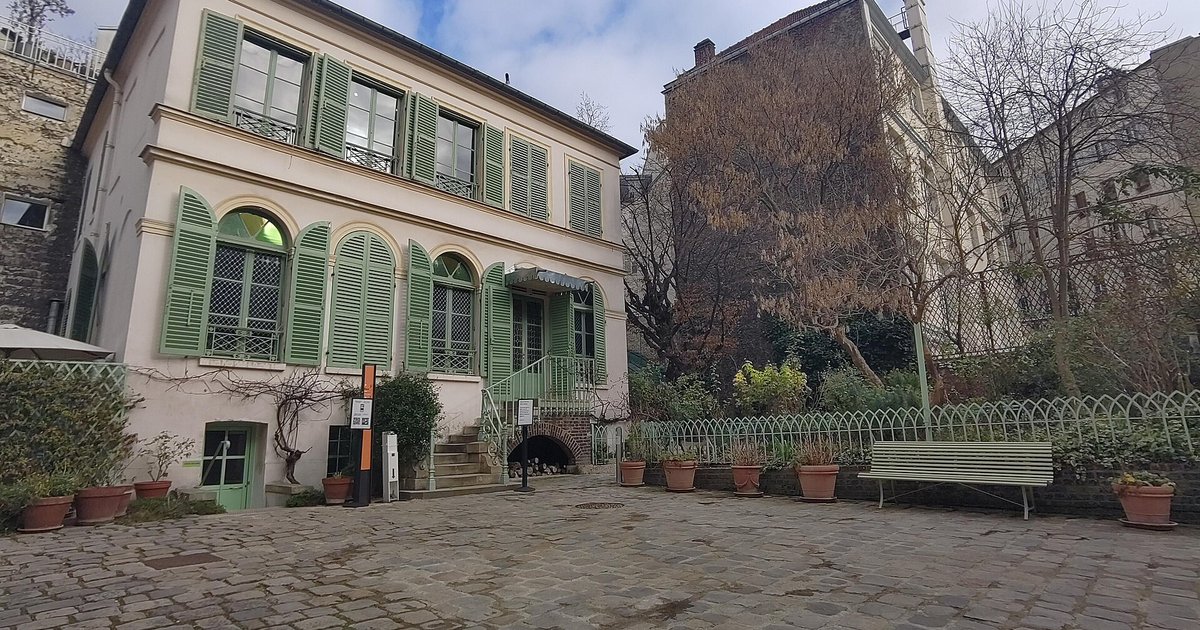
This is our favourite address to recommend. At the end of a cobbled lane off rue Chaptal, a green-shuttered house holds mementos of George Sand and paintings from the Romantic era. In fine weather, the garden and its tea room make you forget you are in the middle of the city.
The Musée Gustave-Moreau
On rue de La Rochefoucauld, the Symbolist painter’s former house and studio keeps its vast workshops covered in canvases and a spiral staircase that has become one of the most photographed in Paris.
Notre-Dame-de-Lorette, La Trinité and Place Saint-Georges
The church of Notre-Dame-de-Lorette, with its richly painted interior, gave its name to the area and to the metro station. A little further west, the church of La Trinité rises above a tree-filled square. Between the two, the round Place Saint-Georges, surrounded by town houses, sums up the quiet elegance of the neighbourhood on its own.
Rue des Martyrs and SoPi: living like a local
The lower part of rue des Martyrs, on the 9th side, is the kind of shopping street people love: bakeries, cheese shops, greengrocers, pastry shops, delis and cafés. It is the ideal place to put together a breakfast or a picnic. Higher up, the area nicknamed SoPi, for South Pigalle, has seen cocktail bars, restaurants and designer boutiques open.
For a breather, avenue Trudaine and its tree-lined central strip invite a stroll, and Square d’Anvers has benches and a playground.
Our practical tips for getting around
The 9th is easy to explore on foot, from south to north, as long as you accept that it climbs. For everything else, the metro is everywhere: Opéra, Chaussée d’Antin–La Fayette, Le Peletier, Cadet, Notre-Dame-de-Lorette, Saint-Georges or Trinité stations depending on your address. RER A stops at Auber, and metro line 14 serves nearby Saint-Lazare station.
All these tips, tailored to the exact address of the flat, are in the digital welcome book given to our guests. Do you own a flat around the Opéra and the department stores, in Saint-Georges or near rue des Martyrs? Discover our guest welcome in the 9th or estimate what your flat could earn.
Frequently asked questions
Can you visit the Palais Garnier without seeing a performance?
Yes. The opera house offers daytime visits, self-guided or guided, outside rehearsals and performances.
Do you have to pay to go up to the Galeries Lafayette terrace?
The panoramic terrace is reached from inside the store and does not require a ticket. It is best to check current conditions before going.
Which is the quietest part of the 9th to stay in?
The streets around Place Saint-Georges and the Nouvelle Athènes are more residential and calmer than the area around the Opéra and the Grands Boulevards.
Photo: Alex Sirac, CC BY-SA 4.0, via Wikimedia Commons

